
Tricid
A self-hosted render engine that turns a designed template into finished images, PDFs and videos from an editor, an API, a signed URL or an AI assistant.
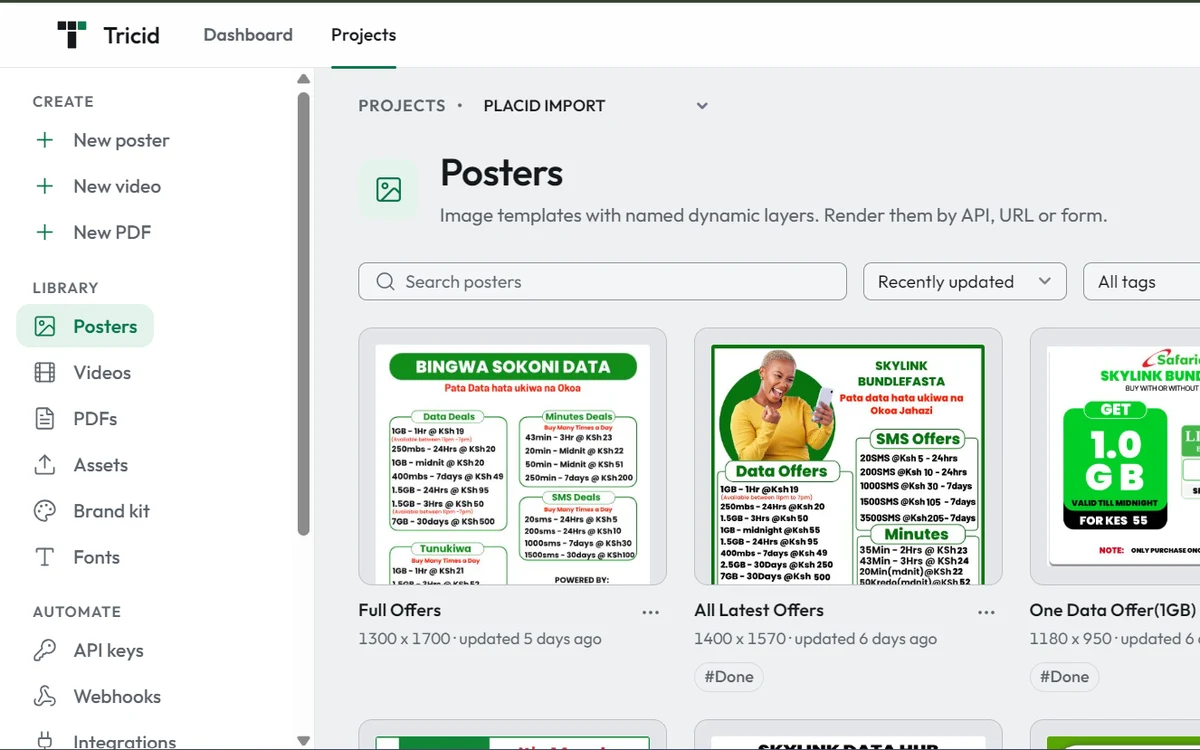
Businesses that produce posters, social graphics, certificates and short videos in volume redo the layout by hand every time a price or a line of text changes, like the daily data-bundle price posters. Hosted render services rent that capability by the render, and your templates and data live on their servers.
Built Tricid as a TypeScript monorepo: a Studio editor with layers for text, images, shapes, SVG and groups, auto-fit text, effects and a timeline for video; a Placid-compatible REST API plus a native /api/v1; and a signed URL API that returns a finished render straight into an <img> tag or an email. Public form pages let visitors generate their own image, bulk Actions render from a sitemap or URL list, and a Placid importer keeps original template UUIDs so existing integrations keep working. An MCP server lets Claude and Cursor create renders, with Zapier, Make and n8n integrations, signed webhooks and scoped API tokens alongside. Rendering runs on headless-Chromium image/PDF, FFmpeg video and speech-to-text captioning workers, hardened with an SSRF guard, SVG sanitiser and rate limits, and covered by golden-image, contract, reliability and load tests in CI with a Docker deploy pipeline.
Posters, PDFs and videos now render on demand from a template library instead of being rebuilt by hand; the project shown holds 42 imported poster templates. It runs in private, single-owner use while hardening and testing finish, with documentation published and no public release yet.
Source is private — the owner does not permit public access to this codebase. A walkthrough is available on request.
More automation work
- WhatsApp AI Sales Agent with M-Pesa CheckoutAn AI sales agent that runs entirely inside WhatsApp — search a real catalogue, get a grounded recommendation, and pay by M-Pesa — with the owner SMS’d the moment a sale lands.
- WhatsApp Bundle Sale AutomationA WhatsApp bot that sells data bundles and confirms M-Pesa payment end to end.
- Order-to-Dispatch Bot for Boutiques & ShopsA WhatsApp bot that takes the order, takes the money, updates stock and calls the rider.